| |

The Hamilton Securities Group had a subsidiary charged
with taking our data as it developed on individual
transactions and portfolio strategy assignments
and using it to develop a new approach to investment.
We sought to help investors understand the impact
of their investments on people and places and on
a wider society as a strategy to identify opportunities
to lower risks and enhance investment returns.[83]This
included understanding how to reduce the dependencies
of municipalities and small business and farming
on debt and increase their ability to finance with
equity. Indeed, easy, subsidized access to equity
financing is one of the reasons that large companies
have grown so powerful and taken over so much market
share from small businesses. Access to equity investment
for small business and farms would result in a much
healthier economy and much more broad-based support
for democratic institutions.
We were blessed with an advisory board of very
capable and committed pension fund leaders. In
April 1997, we had an advisory board meeting at
Safeguard Scientifics where the board chair led
a venture capital effort. I gave a presentation
on the extraordinary waste in the federal budget.
As an example, we demonstrated why we estimated
that the prior year’s federal investment
in the Philadelphia, Pennsylvania area had a negative
return on investment. It was, however, possible
to finance places with private equity and then
reengineer the government investment to a positive
return and, as a result, generate significant
capital gains. Hence, it was possible to use U.S.
pension funds to increase retirees’ retirement
security significantly by investing in American
communities, small business and farms — all
in a manner that would reduce debt and improve
skills and job creation. This was important as
one of the chief financial concerns in America
at that time was ensuring that our retirement
plans performed financially to a standard that
would meet the needs of beneficiaries and retirees.
It was also critical to reduce debt and create
new jobs as we continued to move manufacturing
and other employment abroad. If not, we would
be using our workforce’s retirement savings
to finance moving their jobs and their children’s
jobs abroad.
The response from the pension fund investors
was quite positive until the President of the
CalPers pension fund — the largest in the
country — said, “You don’t understand.
It’s too late. They have given up on the
country. They are moving all the money out in
the fall (of 1997). They are moving it to Asia.”
He did not say who “they” were but did
indicate that it was urgent that I see Nick Brady
— as if our data that indicated that there
was hope for the country might make a difference.
I thought at the time that he meant that the pension
funds and other institutional investors would
be shifting a much higher portion of their investment
portfolios to emerging markets. I was naive. He
was referring to something much more significant.
The federal fiscal year starts on October 1st
of each year. Typically the appropriation committees
in the House and Senate vote out their recommendations
during the summer. When they return from vacation
after Labor Day, the various committees reconcile
and a final bill is passed in September. Reconciling
all the various issues is a bit like pushing a
pig through a snake. Finalizing the budget each
fall can make for a tense time. When the new bill
goes into effect, new policies start to emerge
as the money to back them starts to flow. October
1st is always a time of new shifts and beginnings.
In October 1997, the federal fiscal year started.
It was the beginning of at least $4 trillion going
missing from federal government agency accounts
between October 1997 and September 2001. The lion’s
share of the missing money disappeared from the
Department of Defense accounts. HUD also had significant
amounts missing. According to HUD OIG reports,
HUD had “undocumentable adjustments”
of $17 billion in fiscal year 1998, and $59 billion
in 1999. The HUD OIG refused to finalize audited
financial statements in fiscal year 1999, refused
to find out the basis of the undocumentable adjustments
or to get the money back and refused to disclose
the amount of undocumentable adjustments in subsequent
fiscal years.[84]
The HUD OIG continued to invest significant resources
in persecuting Hamilton during this time.
 |
|
Courtesy: New Yorker Magazine |
|
|
The contractor who was blamed for the missing
money at HUD was a financial software company
named AMS. My old partner, Steve Fenster, the
Dillon Read banker who led the firms effort in
the Campeau leveraged buyout of the Federated
Department Stores which had gone bankrupt (See
my description expressing my concerns to Steve
regarding this deal in “A Parting of the
Ways” earlier in this story), had been a
board member of AMS until his death in 1995, when
he was replaced by Walker Lewis, a board member
affiliated with Dillon Read and now, as Chairman
of Devon Value Advisors, a consulting partner
to Pug Winokur and Capricorn Holdings. With $17
billion and $59 billion missing from HUD, Secretary
Cuomo never fired AMS or seized their money. Indeed
the AMS Chairman Charles Rossotti was appointed
IRS Commissioner and given a special waiver to
keep his AMS stock. As a result, he profited personally
when HUD kept AMS on its contractor payroll and
new task orders were awarded to AMS by the IRS.
As IRS Commissioner, he oversaw the responsibilities
of the IRS criminal investigation division that
plays a special role with respect to money laundering
enforcement during the period when $4 trillion
went missing from the Federal government. When
Rossotti left government service, he joined Lou
Gerstner at The Carlyle Group.
If we assume that the $17 billion went missing
at HUD during 1998 on an even basis — that
is, $1.4 billion a month, $63.6 million per week
day, $7.9 million per working hour — by the
summer of 1998, approximately $14 billion would
have been missing from HUD alone, not counting
other agencies. Where did it go? Was it financed
with securities fraud using Ginnie Mae or other
mortgage securities fraud or fraudulently issued
U.S. Treasury securities? These are important
questions. Interestingly, this was also a period
in which some of the most powerful firms in Washington,
D.C. or with Washington ties were having remarkably
good luck raising capital. Indeed, the period
of missing money coincided, not surprisingly with
a “pump and dump” of the U.S. stock
market and a significant flow of money into private
investors hands.
| PUMP
and DUMP |
| Adapted
from Wikipedia, the free encyclopedia.
The financial fraud known as
“pump and dump” involves
artificially inflating the price
of a stock or other security
through promotion, in order
to sell at the inflated price.
This practice is illegal under
securities law, yet it is particularly
common.
Read
on ... |
|
|
Let’s look at some examples. Cornell Corrections
was far from the only company to raise funds during
this period and Dillon Read far from the only
investor to cash out. Indeed, in the scheme of
things, Dillon Read’s investment in Cornell
Corrections can be described as a financially
modest in size — albeit highly successful
in percentage terms — venture investment.
For example, Dillon’s investment and profits
look tiny when compared to the billions that KKR
was investing in RJR. Whether large or small,
I would argue that both investments are highly
informative regarding the real corporate business
model prevailing in the US and globally.
In the summer of 1998, Carlyle Group announced
that it had closed its European Fund with $1.1
billion. By the end of the decade Carlyle had
more than a dozen funds with close to $10 billion
under management. In the meantime Enron, transacting
with Wall Street, was enjoying a rush of good
luck with offshore partnerships and growing revenues
from “the new economy.” Enron’s
leaders included a “Who’s Who”
of government contracting. Pug Winokur was the
chairman of the Enron finance committee. Pug was
also an investor and board member in DynCorp,
who was running critical and highly sensitive
information systems for DOJ, HUD, HUD OIG and
the SEC. Arthur Anderson, Enron & DynCorp’s
auditor, (also Cornell Correction’s auditor)
was a major contractor at HUD. Frank Savage, a
board member of Lockheed Martin, the largest defense
contractor that at the time was paid more than
$150 million a year to run the HUD information
systems, was also on Enron’s board and finance
committee. Enron and HUD shared all the same big
banks — Citibank, JP Morgan-Chase —
and Wall Street firms. Winokur was on the board
and invested with the Harvard endowment, a large
investor in Enron. The attorney representing his
firm on SEC documents, O’Melveny and Myers,
a prominent Los Angeles firm, was reported to
be the lead firm helping Al Gore during the 2000
election. Harvard University was a HUD contractor
and major source of HUD, Treasury and White House
officials. The Harvard Endowment was a major investor
in HUD real estate and mortgage operations along
with Pug Winokur and his investment company. Harvard
employees were one of the largest groups of lifetime
contributors to Bill Clinton. Harvard was also
a source of appointees for OMB, DOJ, SEC, DOD
and other agencies throughout the government.[85]
During the Clinton Administration the Harvard
Endowment rose from approximately $4 billion to
almost $20 billion, an astounding performance.

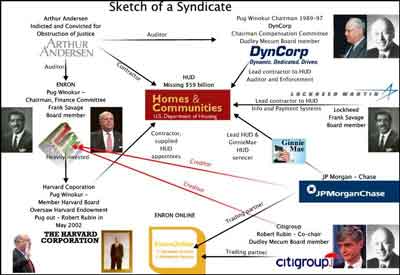
(Graphics: Sanders Research Group, republished
from Scoop Media)
To repeat a critical point made earlier in our
initial discussion of the leveraged buyout business
that has engineered a takeover of America’s
economy — money is like the Pillsbury Doughboy.
When you squeeze down on one part — it pops
up someplace else. While we do not yet know the
truth of who now has $4 trillion (or some other
very large actual amount of cash and/or fraudulently
issued securities) of undocumentable transactions
indicating extraordinary amounts missing from
the U.S. government or trillions more that disappeared
out of pension funds and retail investors stock
holdings during this period, we do know who has
growing financial resources. We also know the
extent to which extraordinary enforcement resources
were used to target many of the honest people.
SRA's highly recommended `Mr. Global' strip
by Justin Ward and Chris Sanders


On December 18, 1997, the CIA Inspector General
delivered Volume I of their report to the Senate
Select Committee on Intelligence regarding charges
that the CIA was complicit in narcotics trafficking
in South Central Los Angeles. Washington, D.C.
’s response was compatible with attracting
the continued flow of an estimated $500 billion–$1
trillion a year of money laundering into the U.S.
financial system. Federal Reserve Chairman Alan
Greenspan in January 1998 visited Los Angeles
with Congresswoman Maxine Waters — who had
been a vocal critic of the government’s involvement
in narcotics trafficking — with news reports
that he had pledged billions to come to her district.
In February Al Gore announced that Water’s
district in Los Angeles had been awarded Empowerment
Zone status by HUD (under Secretary Cuomo’s
leadership) and made eligible for $300 million
in federal grants and tax benefits. At the same
time, the existence of Hamilton’s software
tools and databases would have posed a significant
risk if my team and I had become aware of the
"Dark Alliance" story. The fastest way
to connect the dots would have been for me and
my teammates to have looked at the maps of high
HUD single family defaults contiguous to areas
of significant narcotics trafficking that we had
posted on the Internet and then use the Hamilton
Securities software tools and databases to dig
deeply into government financial flows in the
same areas, including patterns of potential mortgage
and mortgage securities fraud.
 |
|
The Map of South Central
Los Angeles, California
(Map courtesy The Hamilton
Securities Group) |
|
|
The destruction, suppression and theft of our
software tools, databases and computer system
was arranged by a series of events between late
1997 and early 1998 that was so orchestrated throughout
government, media and members of the Council of
Foreign Relations that I would never have believed
it if I had not lived through it.[86]
The Washington Post mysteriously killed
a story about what was happening to The Hamilton
Securities Group at the last minute — just
as they had done with the Mena story in 1995.
Our errors and omission insurance carrier suddenly
refused to pay our attorneys, who withdrew from
representation of The Hamilton Securities Group.
 |
Hayes
Farm, purchased by
Catherine's maternal grandparents
on their honeymoon and passed
down through the generations,
has a panoramic view of Mt.
Washington and the Presidential
Range in the White Mountains
of New Hampshire — but
no electricity. (Photos courtesy
Catherine Austin Fitts) |
|
|
I sold my interest in our family farmland to
my uncle to try to get new attorneys to manage
the assault of legal and investigatory workflow
coming our way. The HUD OIG then called my uncle,
apparently trying to persuade him that I was a
criminal, and sent four HUD OIG and FBI agents
to his home in New Hampshire at night with a subpoena.
Their pretext was that they needed to review the
family financial records for the farm to see if
I had been entertaining government employees at
this “vacation resort.” In time they
would come to understand that no government officials
had ever joined me at the farm and that the farm
did not have electricity and depended on an outhouse
for “basic” functions.
Judge Sporkin ruled against us in our efforts
to get HUD to pay us immediately monies owed for
work performed and then, for no legitimate reason,
authorized our digital records and papers to be
seized. On March 8, 1998, a court representative
with a team of HUD OIG and FBI investigators landed
in our offices and took them over. All copies
of all documents whether in our office or in our
homes and personal possessions were turned over.
We were not allowed to keep copies of anything.
We had been ordered by HUD to wipe all HUD databases
from our server — most of which were available
to the public by law — and certify that they
had been wiped clean. We were told we could get
copies or excess items of what had been turned
over back quickly. In fact, with the exception
of one server and a few computers, it took many
years to recover any of our files. By the time
our most critical files were returned to our control,
our most valuable software tools had “disappeared”
while under court control.
We were later to discover that DOJ was using
CACI as a litigation support contractor on our
case. CACI was the leading supplier of Geographic
Information Systems software and services to the
U.S. government who later was in the headlines
as a result of their connections to the prison
at Abu Grahbi in Iraq. This begs the question
whether DOJ was paying our competitor to help
themselves to our proprietary software and databases.
Some time after our entire digital infrastructure
was taken over, DOJ came out with a geographic
information systems mapping tool to help support
increased community policing and enforcement product.
You had to wonder if this was the “Sheriff
of Nottingham’s” answer to Community
Wizard — rather than using software to allow
citizens to understand what government was doing,
why not use software to provide increased surveillance
of citizens by government.
While in possession of our offices, the HUD OIG
investigators took empty shredding bins, filled
them up with trash and then — from a separate
floor — found and added corporate accounting
files and then staged photo-taking by the HUD
IG General Counsel, Judith Hetherton, who then
sent us a letter alleging obstruction of justice
as evidenced by our “throwing out” corporate
accounting records. We were saved by a property
manager who witnessed this charade and decided
to help us out after he saw the intentional —
and very disgusting — trashing of the The
Hamilton Securities Group offices and was touched
by our efforts to clean it up. The property manager
had come to the U.S. from Latin America—presumably
to find freedom from lawless government. One of
our attorneys went into the office when the federal
investigators were there and came out shaking.
He said to me, “My parents left Germany to
get away from these people. Now they are here.
Where do I go?”
Meanwhile, as soon as The Hamilton Securities
Group’s digital and paper records and tools
were under court control, computers auctioned
off and websites taken down, Congress held surprise
hearings on March 16, 1998 on Volume I of the
CIA Inspector General’s Report on Gary Webb’s
"Dark Alliance" allegations about government
involvement in cocaine trafficking. The CIA Inspector
General during these hearings disclosed the existence
of the Memorandum of Understanding between the
CIA and DOJ that had been created in 1982. Sporkin,
the judge who had just engineered the destruction
of Community Wizard and our digital infrastructure
and had the carcass under his control, was the
CIA General Counsel when that MOU was engineered.
There was one small glitch. When we were next
allowed in our offices one evening in mid-March,
we took the main server and brought it back to
my home. The next day, a HUD auditor was stunned
to see it gone — he assumed that everything
would be wiped clean and sold. He asked where
the server was and one of my partners said, “we
took it last night.” At which point the HUD
auditor said, “You can’t do that. My
instructions are you are not allowed to have any
of the knowledge.” He then could not come
up with a rational reason or lawful basis as to
why that was so and why The Hamilton Securities
Group was to be denied access to its own property.
While the private prison companies were booking
more contracts and billions of dollars were going
missing from HUD, I spent the next months slugging
through hundred-hour work weeks managing some
eighteen audits, investigations and inquiries
and twelve different tracks of litigation while
struggling under the drain of significant physical
harassment and surveillance and an ongoing smear
campaign.
Information was dribbling out which ultimately
would provide relief. Congresswoman Waters read
the Memorandum of Understanding between the CIA
and DOJ into the Congressional Record in May.
Then in June, Gary Webb published his book Dark
Alliance. I saw a brief piece pooh-poohing
it in a corporate magazine and realized that somehow
this might help explain the insanity that I was
dealing with and could not understand.
After reading Dark Alliance, I started
to study the extraordinary moneymaking business
that DOJ and agencies like HUD had built in enforcement
that really only made sense if in fact the government
was entirely complicit in narcotics trafficking
and related mortgage and mortgage securities fraud.
I started to realize the extent to which private
information systems and accounting software companies
like DynCorp and AMS were taking control of government
agencies behind the scenes — thus creating
the conditions for billions of dollars to disappear
from government accounts. Then I started to research
private prison companies when a banker from our
bank — whose colleagues' behavior had been
egregious and I believe criminal towards us—told
me how much money they were making in Washington
D.C. gentrification and private prisons. This
was a theme that kept repeating itself during
this period. Private prisons were the next “big
thing” and were going to be “real money
makers.” It was not just Scott Nordheimer
who had tried to persuade us of this. When I had
met with several senior partners of Coopers &
Lybrand in late 1994, they assured me that I should
shift my focus from communities to prisons —
that the future was in enforcement and prisons.
In September, I discovered that DOJ owned a prison
business company, the Federal Prison Industries,
marketed by the name of UniCor. It markets federal
prison labor to federal agencies. It turns out
that Edgewood Technology Services, a Hamilton
Securities Group brainchild and investment, was
a potential competitor with DOJ’s own prison
company for federal data servicing contracts.
UniCor’s website indicated that they had
a growing data servicing business with a focus
on Geographic Information Systems (GIS) software
products — the same as Edgewood Technology
Services. It made me wonder if Scott Nordheimer
had given DOJ and its Federal Bureau of Prisons
our business plan despite my insistence that we
were not interested in prison opportunities. I
called the head of the data-servicing group in
UniCor, who was amazed to hear the story I told
him. He said something to the effect of: “That
makes no sense. Most people end up in prison because
they cannot get good jobs. It is much more expensive
to have them working in prison than not come here
in the first place.” He was eager to meet
with me, as he was interested in helping good
data servicing workers find jobs when they left
prison. I told him to check with his superiors
and that I would love to meet with him. He never
called me back.
| Federal
Prison Industries
The Department of Justice’s profits
from prison labor grew along with the growth
of federal prisoners — the vast majority
of whom were non-violent offenders. An April
12, 2004 story in Government Executive magazine,
Prison labor program under fire by lawmakers,
private industry, by K. Daniel Glover
shows the rise of DOJ’s prison sales
and labor force as more arrests and incarcerations
are good for business.
Federal Prison Industries'
Growth
| Year |
Number of
Factories |
Sales
(Millions) |
FPI Workers |
Total Inmates |
Product Groups |
| 1985 |
71 |
$238.9 |
9,995 |
36,042 |
4 |
| 1990 |
80 |
343.2 |
13,724 |
57,331 |
5 |
| 1995 |
97 |
459.1 |
16,780 |
90,159 |
5 |
| 2000 |
105 |
546.3 |
21,688 |
128,122 |
5 |
| 2001 |
106 |
583.5 |
22,560 |
156,572 |
8 |
| 2002 |
111 |
678.7 |
21,778 |
163,436 |
8 |
| 2003 |
100 |
666.8 |
20,274 |
172,785 |
8 |
Source: Federal Bureau of
Prisons, quoted at http://www.govexec.com/dailyfed/0404/041204nj1.htm
A report from The Center for Public Integrity
in September 2004 reported that the Federal
Prison Industries was the 72nd largest defense
contractor with $1.4 billion of contracts
between 1998-03, describing it as follows:
“Federal Prison Industries,
also known as UNICOR, uses federal prisoners
to manufacture a wide variety of products
including furniture, clothes and electronic
equipment. It also provides administrative
services such as data entry and bulk mailing.
A government-owned corporation, it operates
as a part of the Federal Bureau of Prisons
and is the Defense Department's number
one supplier of clothing, furniture, and
household furnishings.”
|
Then on October 8th, an hour after the House
of Representatives voted to move forward with
the Clinton impeachment hearings, the CIA quietly
posted Volume II of the CIA Inspector General
report on the "Dark Alliance" allegations
on their website. Volume II included a copy of
the Memorandum of Understanding between DOJ and
CIA. The message from President Clinton to the
Republicans was simple and clear. “You take
me down and I will take everyone down.” Literally
the next day, October 9th, Secretary Andrew Cuomo
issued a series of sole source contracts through
Ginnie Mae, the mortgage securities operation
at HUD, to John Ervin’s company (the same
company leading the qui tam lawsuit against Hamilton)
and to Touchstone Financial Group, a firm apparently
started by a former Hamilton Securities Group
employee who brought on a series of former Hamilton
people to do some of the Hamilton work for HUD.
One can only make a list of more unanswered questions
of the political deals that may have been happening
behind the scenes. After all, October 1, 1998
was the beginning of the fiscal year in which
HUD was missing $59 billion from its accounts
— for which the HUD OIG was to refuse to
provide an audit as required by law. This amount
of money translates into $4.9 billion per month,
$1.2 billion per work week or $30.7 million per
work hour. This was somebody’s payback time.
 |
| A
FOIA response by HUD indicated
that HUD Secretary Andrew Cuomo
had engineered Ginnie Mae contracts
for Ervin in October 1998 that
could help finance Ervin's lawsuits
against HUD and Hamilton Securities. |
|
|
 |
 |
|
| |
Ike
Kohn
(Courtesy
Institute of Advanced Studies) |
|
|
|
Disgusted with events in Washington during this
period, I headed to New York to try to get a sense
of what this meant on Wall Street. I went down to
Wall Street to have lunch with Bart Friedman, one
of the partners at Cahill Gordon, Dillon Read’s
lead law firm. Bart was someone I had immense respect
for and who had helped Hamilton with our legal work.
As we were having lunch at a private club near Cahill,
Bart's senior partner, Ike Kohn, walked by. When
I was at Dillon Read, Nick Brady would introduce
Ike as our most trusted attorney. Bart said something
to the effect of, “Ike, you remember Austin
Fitts.” Ike looked at me and sneered with hostility
and walked away abruptly in a manner that was shocking
to me. At least it was shocking until I saw the
SEC filings for Cornell Corrections. Bart Friedman
had handled all of Dillon’s investment and
underwriting files for Cornell Corrections. While
Ike may have been scared that I might connect the
dots at lunch, I did not. I plowed through the SEC
documents for Wackenhut Corrections and Corrections
Corporation of America. I did not look at Cornell
until years later. To this day I wonder what Ike
knew about what happened to The Hamilton Securities
Group.
 |
| |
| It's
a Small World: While
Cahill Gordon & Reindel was
helping Dillon Read build Cornell
Corrections, it was also providing
legal counsel to The Hamilton
Securities Group. |
|
|
I then headed to a birthday party for a member
of the family of a Dillon Read partner being held
at the Colony Club, an elegant private club on
Park Avenue. A rush of friends wanted to know
what I thought of prison company stocks. They
were all in them, the brokers were pushing them,
they were the “new hot thing” and they
were anticipating delicious profits. I said get
out, the pricings assumed incorrectly that piling
people into prisons — the innocent and guilty
alike — was like warehousing people in HUD
housing. Sure enough, the stocks were to later
plummet. But not until the Wall Street Journal
ran a story about decorators using prison equipment
to do bathrooms and kitchens on Park Avenue and
Esquire ran a fashion layout in front
of a series of jail cells. To this day, I wonder
how many of the people I spoke to that evening
had bought Cornell Corrections stock from Dillon
Read.
I came back to Washington, D.C. feeling that
the world had indeed gone mad. Everywhere I turned
I saw people who seemed quite happy to make money
doing things that drained and liquidated our permanent
infrastructure and productivity as a people and
a nation. Our financial system had become a complex
mechanism that allowed us to profitably disassociate
from the sources of our cash and concrete reality.
After several conversations with my attorneys,
I realized that the efforts to frame us had failed
and now those involved had been left with a bit
of a mess as we were turning in the court affidavits
that documented intentional falsification and
suppression of evidence. My assessment was that
DOJ would be willing to drop everything if we
simply let them keep all of The Hamilton Securities
Group’s money. Whatever the urgent thrust
had been, it was over. Was it because Dillon had
now cashed out all of their money? Was it because
all of the software tools and databases were effectively
suppressed and would not lead millions of Americans
to connect mortgage fraud with the Dark Alliance
story? Was it because the covert cash spigot had
been turned on and $59 billion was pouring out
of HUD to feed the hungry beast the appetizer
followed by a main course of $3.3 trillion missing
from the Pentagon? Was it because, with honest
people forced out and the bureaucracy properly
terrorized, the housing bubble was now being fueled
with explosive federal credit from FHA, Ginnie
Mae, Fannie Mae and Freddie Mac? Or was it a combination?
More than anything, there had been a very intense
and personal desire to see me in prison. It had
failed. I made a decision that I was not going
to simply walk away. I was going to get to the
bottom of what happened.
What communities in America and worldwide most
need is the truth. We need the ability to know
whom we can trust and who we cannot trust. We
need to know how to build a life, a family, a
small company, and retirement savings and be able
to protect them from corruption. We need to generate
an income that builds up our wealth and equity,
rather than a subsidy that keeps us going while
our equity slowly drains out of our savings and
our communities. Any successful explorer will
tell you that all the resources in the world are
of little use if you have a bad map and as a result
end up naked to the elements.
 |
| |
Catherine's
Home, Fraser Stables,
a converted carriage house and
stables in downtown Washington,
D.C. was sold to help defray
the expenses of litigation and
escape ongoing physical harassment
and surveillance. (Photos courtesy
Catherine Austin Fitts) |
|
|
The first step was to understand organized crime
— a topic that I had never been interested
in. I called an organization that sold tapes by
researchers on government corruption and narcotics
trafficking and bought the tapes he recommended.
So began a journey of reading and watching thousands
of books and videos and networking with researchers
globally.
Later that year, I published an article about
the potential connection between the Dark
Alliance allegations and the efforts to suppress
our transparency tools and what that may imply
regarding the possible use of HUD mortgages and
mortgage fraud by these same networks. Right after
the article was published on May 22, 1999 with
copies delivered to the Intelligence Committee
subscribers, Congress suddenly held closed hearings
on Volume II of the CIA Inspector General’s
reports, taking testimony in secret from DOJ Inspector
General Michael Bromwich and CIA Inspector General
Britt Snider.[87]
It was clear where things were going by that
summer. In June of 1999, Richard Grasso, Chairman
of the New York stock exchange, went to Colombia
to visit a Revolutionary Armed Forces of Colombia
(FARC) Commander to encourage him to reinvest
in the U.S. financial system. At the time of his
visit, the General Accounting Office reported
on FARC’s growing influence in the Colombian
cocaine market.[88]
 |
| Richard Grasso
hugging a FARC Commander in 1999
in a rebel village in Colombia at
the time the GAO reported that FARC
had assumed control of a majority
market share of the Colombian cocaine
trade. (Photo courtesy
LaRouche Campaign) |
|
As I learned more about the black budget and covert
cash flows at work in our economy, I also learned
more about their history. I began to connect more
of the dots to my personal history and that of
my family, friends and neighbors. I realized that
the viciousness of the current attack could relate
not just to my work at Hamilton but to problems
that my family had dealing with similar, if not
the same, people long ago. [88.5]
It only served to reinforce the wisdom of my decision
to pursue the litigation and get to the bottom
of what was happening and why. In the famous words
of George Santayana, "those who do not learn
from history are doomed to repeat it." I
was to spend many years resolving the litigation
and building new networks that I needed to found
and grow my investment advisory company —
helping to preserve and grow family wealth in
a world increasingly defined by financial and
political corruption.
|
|


